
Turnings
Life and literature

Intertextuality is how a text’s meaning is shaped by its relationship to other texts, both explicitly and implicitly. It is one of my favourite things about reading, and maybe about writing too (says person who used a title for her book that was the title of an older book).
Intertextuality is not only about texts referencing each other to demonstrate a genealogy of ideas, but it is also the wonderfully idiosyncratic nature of a particular reader, reading a particular text, at a particular time. Intertextuality can also be accidental on the part of the writer. In this sense intertextuality is like a secret love note tucked into book. It is letter across time and space only recognisable to those who elect to be part of the conversation1.
My grandfather, Gerald, joined the Royal Navy in the Second World War. His ship, HMS Hermes, an aircraft carrier, was destroyed by the Japanese and went down on 9 April 1942 in the Indian Ocean, close to Trincomalee, a port city in Sri Lanka. He was lucky to survive. He spent twelve hours in the water while the ship burned before being rescued.
Gerald had a brother (or was it half-brother?) who had a daughter, Wendy Woodward, who became a poet (amongst other things). She wrote a book of poems in 2015, A Saving Bannister, that was published by a small South African press, Modjaji Books (Modjaji Books Newsletter). In this book is a poem about how alternative courses of action, thought, and history, are invisibilised by what did happen as opposed to what didn’t2.
Anyway, Gerald had a daughter, Amanda, who was Wendy’s cousin. Amanda had a daughter who wrote a book about being a daughter (of a clergyman), published by a small South African press, Modjaji Books.
Amanda and Wendy had not seen each other for many years. Certainly, they had not spoken about family writing and small South African presses. Wendy read my book, and contacted my mother, and they caught up. My mother then shared this poem, written by her cousin, about her father, with me.
These turnings filled me with a sense of “astonishment” and joy at the shared “humour”, “irony” and “luck” in the retelling of family stories that find purchase with readers (and publishers!) who know that entire histories are contained in suburban Sunday teas.
Here is the poem. I loved it.
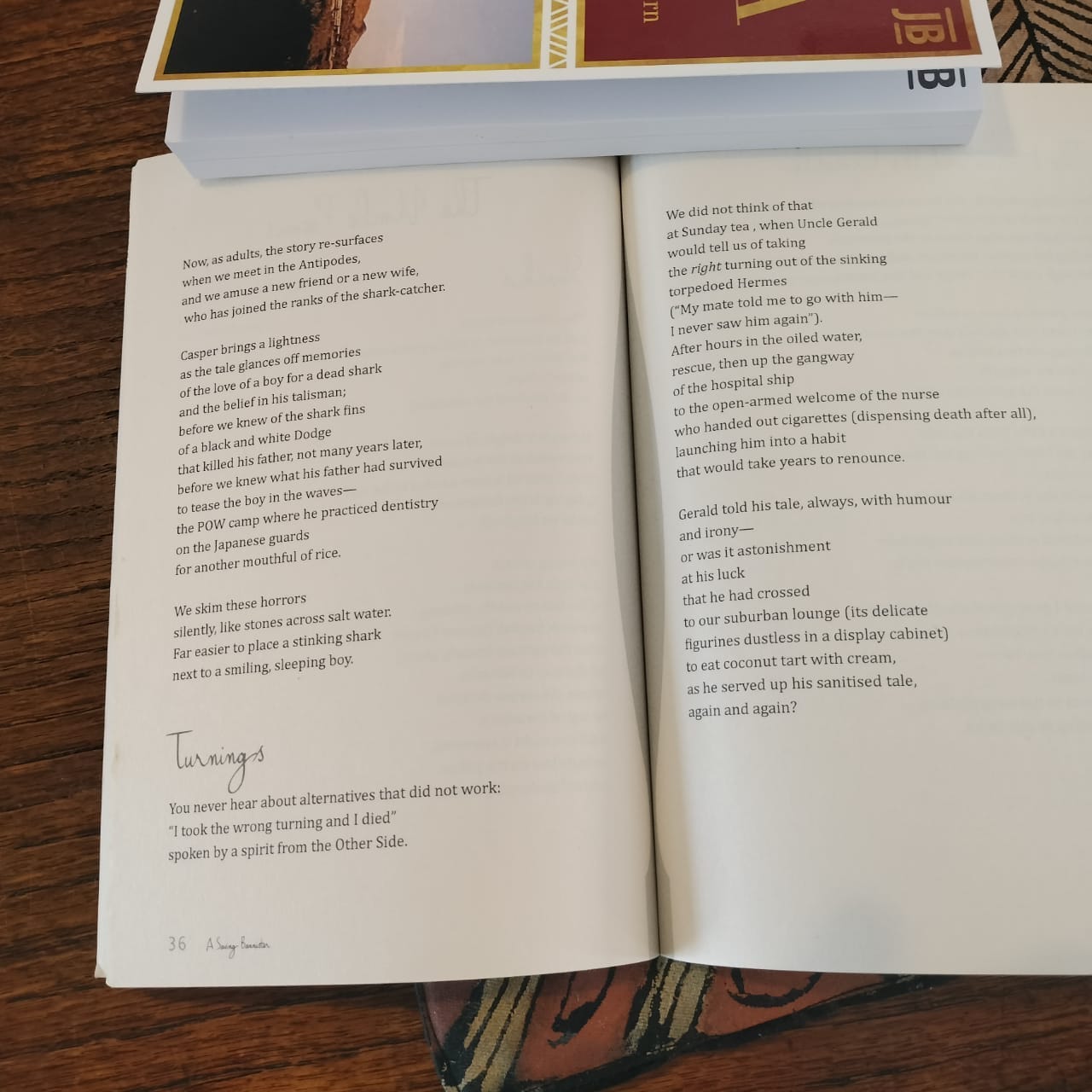
Turnings
You never hear about alternatives that did not work:
“I took the wrong turning and I died”
spoken by a spirit from the Other Side.
We did not think of that
at Sunday tea, when Uncle Gerald
would tell us of taking
the right turning out of the sinking
torpedoed Hermes
(“My mate told me to go with him -
I never saw him again”).
After hours in the oiled water,
rescue, then up the gangway
of the hospital ship
to the open-armed welcome of the nurse
who handed out cigarettes (dispensing death after all),
launching him into a habit
that would take years to renounce.
Gerald told his tale, always, with humour
and irony —
or was it astonishment
at his luck
that he had crossed
to our suburban lounge (its delicate
figurines dustless in a display cabinet)
to eat coconut tart with cream,
as he served up his sanitised tale,
again and again?
- Wendy Woodward, A Saving Bannister
If you are a massive nerd like me and want to read up more on this and related topics. I highly recommend reading The Dialogic Imagination by Mikhail Bakhtin. Best of luck. It is dense.
A theme explored in one of my favourite books, Life After Life by Kate Atkinsons.
How lovely all this is! and can't believe you and Wendy are related! (I know her a little bit from the Grail writers.)
Extraordinary. Dense is an apt description for that book.