
Subterranean Philosophy
and The Great Conversation

Why does it feel embarrassing to be honest about one’s dreams? Is it because it always feels tinged with a bit of childish naivity? Or are we just desperately scared of failure? Of saying, I really want something, and then when it doesn’t arrive you feel not only bereft by the nothing that came of your hopes but the compounded effect of feeling like you have egg on your face?
I read Tuesdays with Morrie years ago1, I can’t remember exactly when. Maybe I was at university or late high school. But I remember my young, childish (in the best sense) self being so taken by the sociology professor, Morrie Schwartz. How I remember him, which of course is probably different to the book - with all memories being collages of what really happened, our own desires and projections, and human fallibility - was being this intensely interesting person, concerned with sharing his wonder of life with others. Not some doe-eyed sentimentality about the beauty of life, but really wanting people to engage with this thing we call being human. To set aside all utility, and ask Big Questions. And I loved that. I wanted that to be my job. I wanted to read interesting books and talk about them with people, and maybe even teach some of these books to people just discovering that life is more complex than we imagined (students). I wanted to be part of The Great Conversation.
Fast forward fifteen years, and I had dipped my toes into academia. A freshly minted PhD, a postdoc underway, some teaching experience, a few publications, and then I fell pregnant.
Well anyone who has become a parent knows how utterly and completely it changes you. There are many ways to go about it. Many ways to create a family. Many ways to parent. But I am not a multi-tasker. I can’t even cook dinner with people around because of how distracted I get. I am easily flustered. I like clear plans. I like control. I like predictability. I like quiet. I like focus.
You can only imagine what parenthood did to that combo of traits. So down the rabbit hole I went. Lots can be said about the intervening seven years. But there are two related points for what I’m writing about here today.
“Having [a] child[ren] when I did has been one of the major strokes of good fortune in my life.”
This is from the collected diaries of Helen Garner, “How To End A Story”, that I am currently reading. I am obsessed. They are compulsive. If you are a woman and a writer or a compulsive diary-keeper, I highly recommend reading them. In the forward to the volume Leslie Jamison writes that Garner’s ex-husband accused women’s writing of lacking ‘an overarching philosophy’.
Jamison says, ‘while it’s true that there’s nothing I would call an “over-arching philosophy” spanning these diaries, they give us something far better, with a slyer more inviting architecture: not overarching but subterranean, deftly emerging from the rough terrain of experience’.
What are the tenets of this subversive, subterranean philosophy? It has more to do with cleaning the dishes, or making breakfast for a grandson, or sitting down for tea with a friend, than it does with utterly silent lunches Garner recalls the composer Igor Stravinsky demannding from his family. At its core, this subterranean philosophy believes that the obligations ad distractions of daily life are not distractions at all: they are the conduits through which we arrive at profundity; they are midwives of grace and insight [my emphasis]. It believes that humility and surprise are the cornerstones of both rigorous self-knowledge and moral action. The more willing we are to be surprised by ourselves, other people, and experience, the more we are capable of honesty, discovery, care, and transformation.
So I went down deep into the mundane, the everyday, and I thought, okay, this is it, this is life now.
So thoroughly did I drink my own kool-aid about the importance of domestic life that I thought I’d never work again, I’d never produce again, and that it was now my life’s work to find an internal locus of purpose, which, of course, kids easily provide. And to be honest is still largely the case. I won’t ever regret being fully tethered to my small home life, because it taught me to find joy and meaning and self-worth outside of the metrics of professional life.
It must be said this is was not a straighforward journey at all. For years I felt lost, confused, I didn’t know where to find my affirmation. I looked for it in some wrong places. There were days when all I wanted was for someone to give me a performance appraisal or a report and say well done, you’re doing well, that’s an A.
I hated the awkward conversations that started with, ‘so, what do you do?’. I always felt like I had to make up some narrative about why I was a stay-at-home mom.
Somewhere along the way, something of my previous ambitions and desires was reignited. And the lessons I had learnt in the subterranean time suddenly seemed to have broader purchase, seemed to offer me a new way in to my old dreams and I started writing.
What has happened since that shift has completely exceeded my expectations. I am hardly some huge success by any metric that matters to the outside world. But for me, it has been huge.
Last week I was in Cape Town and I had three well-attended events of people who were sitting there listening to me prattle on and all I could think was what on earth are they listening to me for? This is ridiculous. But then I also felt so happy. So energised that the young mother in her subterranean phase was now living another version of life. A new phase. Completely different to the one before, but somehow bringing all those childhood hopes and dreams and ambitions back into the light.
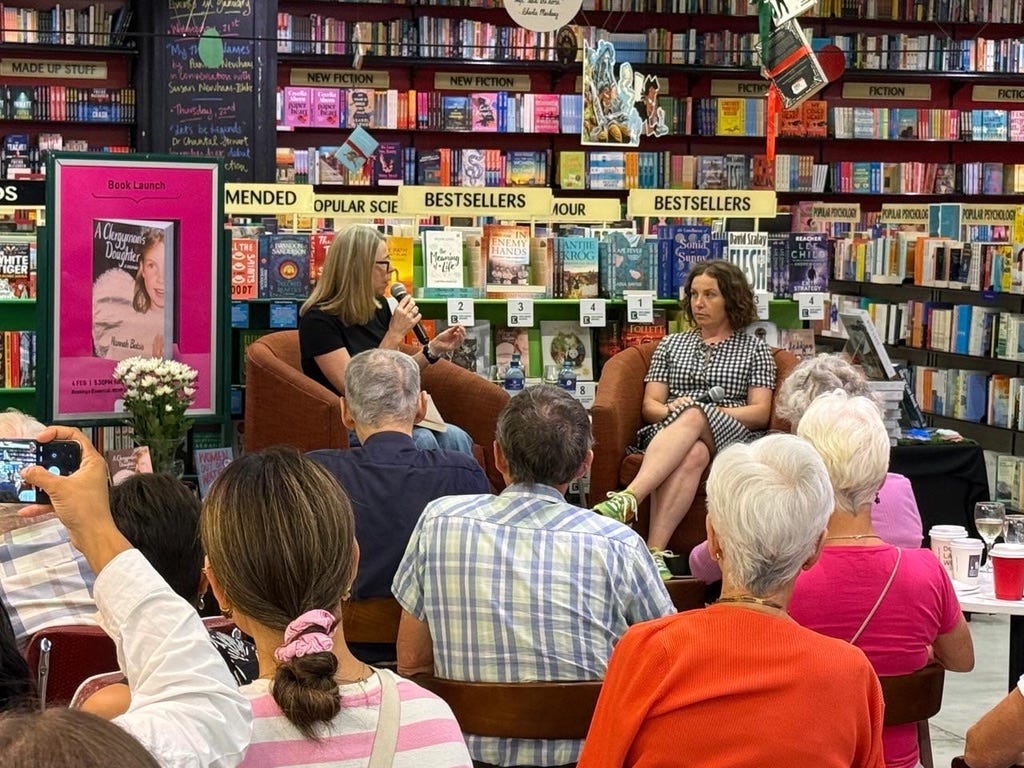
Maybe it was one of the most adult emotions I’ve ever felt. This ability to look back and see patterns and mutations, hills and valleys, and see yourself as a combination of things, a self you didn’t realise you were becoming, but then in a scene (?), or thought (?) or bracketed moment of reflection, you see youself from the outside and you feel proud. Not proud like, I’m so great look at me, no, a pride that is more akin to what you feel when you see your child realise they can do something and they suddenly feel proud of themselves. That kind of disbelief and joy all rolled into one.
So, while I might never be a sociology professor, I did feel like I was returning to my first love: The Great Conversation about what it means to be human.
[You should probably stop reading here, I thought this would be the natural end to my column this week, but I also wanted to include what comes next, but it is getting very long. So if you’re signing off now, thanks for reading.
And to all the new readers here, HI and THANK YOU! You will come to see that these columns are dashed off at speed and are really a collection point for the pools of words in my head that have to go somewhere. So I put them here.
I have a few of my books left in my private stash, so if you were thinking of buying one, please do so here.]
David Brooks, long time columnist at the New York Times, wrote his last column a few weeks ago.
In his piece he tracks the large scale cultural changes that have taken place over the past 20 to 30 years. While he is writing about America, there are many commonalities given how globalised culture now is. Also his tenure helpfully parallels my own journey to adulthood. I quote at length (it is worth reading the entire piece).
‘When I think about how the world has changed since I joined The Times, the master trend has been Americans’ collective loss of faith — not only religious faith but many other kinds.’
‘Loss of faith produces a belief in nothing. Trump is nihilism personified, with his assumption that morality is for suckers, that life is about power, force, bullying and cruelty.’
’It’s tempting to say that Trump corrupted America. But the shredding of values from the top was preceded by a decades-long collapse of values from within. Four decades of hyperindividualism expanded individual choice but weakened the bonds between people. Multiple generations of students and their parents fled from the humanities and the liberal arts, driven by the belief that the prime purpose of education is to learn how to make money.’
‘We’re abandoning our humanistic core. The elements of our civilization that lift the spirit, nurture empathy and orient the soul now play a diminished role in national life: religious devotion, theology, literature, art, history, philosophy.’
‘As a result of technological progress and humanistic decay, life has become objectively better but subjectively worse. We have widened personal freedom but utterly failed to help people answer the question of what that freedom is for.’
‘The most grievous cultural wound has been the loss of a shared moral order. We told multiple generations to come up with their own individual values. This privatization of morality burdened people with a task they could not possibly do [my emphasis], leaving them morally inarticulate and unformed. It created a naked public square where there was no broad agreement about what was true, beautiful and good. Without shared standards of right and wrong, it’s impossible to settle disputes; it’s impossible to maintain social cohesion and trust. Every healthy society rests on some shared conception of the sacred — sacred heroes, sacred texts, sacred ideals — and when that goes away, anxiety, atomization and a slow descent toward barbarism are the natural results.’
‘How can we reverse this pervasive loss of faith in one another, in our future and in our shared ideals? I do not believe that most people can flourish in a meaningless, nihilistic universe. Despite what the cynics say, I still believe we’re driven not only by the selfish motivations but also by the moral ones — the desire to pursue some good, the desire to cooperate, to care for one another and to belong.’
‘Where do people and nations go to find new things to believe in, new values to orient their lives around? Where do they go to revive their humanistic core? They find these things in the realm of culture. In my reading of history, cultural change precedes political and social change. You need a shift in thinking before you can have a shift in direction. You need a different spiritual climate.’
‘By “culture,” I don’t just mean going to the opera and art museums. I mean “culture” in the broadest sense — a shared way of life, a set of habits and rituals, popular songs and stories, conversations about ideas big and small. When I use the word “culture,” I mean everything that forms the subjective parts of a person: perceptions, values, emotions, opinions, loves, enchantments, goals and desires. I mean everything that shapes the spirit of the age, the moral and intellectual moment, which constitutes the shared water in which we swim. In this definition, every member of society has a role in shaping the culture. We all create a moral ecology around ourselves, one that either elevates the people we touch or degrades them.’
‘If you want to jump in on the side of humanization, join the Great Conversation [my emphasis]. This is the tradition of debate that stretches back millenniums, encompassing theology, philosophy, psychology, history, literature, music, the study of global civilizations and the arts. This conversation is a collective attempt to find a workable balance amid the eternal dialectics of the human condition — the tension between autonomy and belonging, equality and achievement, freedom and order, diversity and cohesion, security and exploration, tenderness and strength, intellect and passion. The Great Conversation never ends, because there is no permanent solution to these tensions, just a temporary resting place that works in this or that circumstance. Within the conversation, each participant learns something about how to think, how to feel, what to love, how to live up to his or her social role.’
So what has this got to do with anything? (I’m starting to lose track myself.)
I think it is that my passion for The Great Conversation has never disappeared, but I’ve realised that it can happen, and perhaps must happen, or happens most productively and sustainably, amid ‘the obligations and distractions of daily life’, because these messy things, these tiring, mundane things, are the ‘midwives of grace and insight’. If we are to fix our culture, it has to be from the inside out. And that sometimes a detour, a fallow season, is the best thing for you.
[wikipedia] Tuesdays with Morrie: An Old Man, A Young Man and Life’s Greatest Lesson is a 1997 memoir by American author Mitch Albom about a series of visits he made to his former Brandeis University sociology professor, Morrie Schwartz, as Schwartz was dying from amyotrophic lateral sclerosis (ALS).
Just yes to all this. My dad and I have been talking about that Brooks and his work lately. I love this re-awakening you are having and how messy and beautiful it is. Please keep sharing. Feels very holy.
Love this, thank you! ❤️